
Hewlett Packard Enterprise (HPE) is gearing up for 2025 with substantial upgrades to its supercomputing hardware, with a specific focus on networking, compute, and storage innovations.
Each upgrade is strategically geared towards reinforcing HPE's positions in the HPC and AI markets through next-generation capabilities offered through its Cray EX and ProLiant XD systems.
Networking Upgrades: Slingshot 400
It also said it is now launching the Slingshot 400 as its future interconnect for its Cray EX systems, set to become generally available this Fall 2025, with a strong focus on doubling performance while optimizing to achieve maximum power efficiency.
Key upgrades include
- The Rosetta-2 Switch ASIC, built on TSMC's 7nm process.
- It features doubled signaling speeds to 112 Gb/sec per lane, delivering an impressive 400 Gb/sec per port.
- Similarly, the Cassini-2 Network Adapter ASIC matches this 400 Gb/sec throughput and is fine-tuned for demanding HPC workloads.
HPE looks forward to future upgrades in Slingshot 800 in 2027 and Slingshot 1600 in 2029 targeted at 800 Gb/sec and 1.6 Tb/sec bandwidths, respectively.
Compute Enhancements
HPE is launching a family of advanced compute offerings to advance its Cray EX and ProLiant XD offerings to deliver increased power, flexibility, and performance for a variety of demanding workloads.
Updates are tailored to meet the changing needs of HPC and AI applications, giving users the ability to optimize their systems for traditional high-performance computing challenges as well as for more modern AI-driven ones.
Cray EX Compute Blades
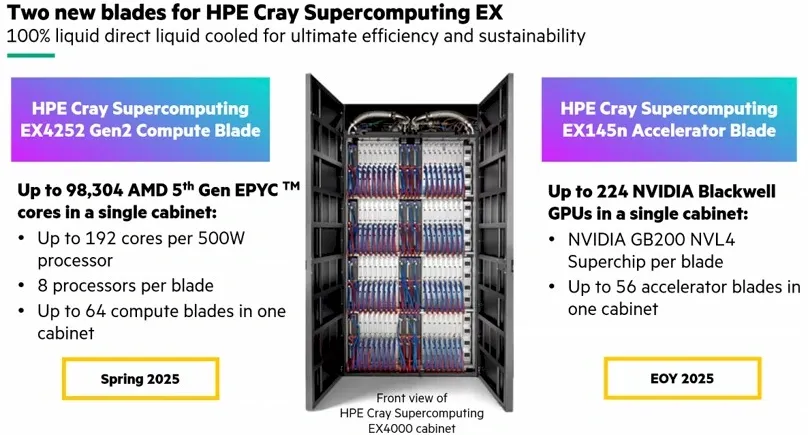
The Cray EX portfolio will have two new compute blade options in 2025, including:
- EX4252 Gen 2 Blade (Early 2025):
This blade is driven by AMD's Epyc 9965 processors, with 192 Zen 5c cores at 2.25 GHz. Each of the blades can accommodate up to eight CPUs, while a single EX4000 chassis is capable of housing 64 blades, totaling an unprecedented 98,304 cores in a rack.
The performance here is as high as 1.77 petaflops per rack at base clock speeds, potentially scaling to ~2 petaflops with turbo.
- EX154n Blade (Late 2025):
HPE will introduce the Nvidia Grace-Blackwell GB200 NVL4 board, with a hybrid architecture having 4 Blackwell GPUs and 2 Grace CPUs per board. Each EX4000 cabinet will have 56 blades, which means 224 GPUs per rack, and ~10 petaflops per rack.
This configuration provides strong balance between compute density and memory capacity, including 42 TB HBM3E and 52.9 TB LPDDR5.
ProLiant XD Systems
For AI-centric and enterprise customers, HPE is refreshing its ProLiant XD line with two new systems specifically optimized for accelerated workloads.
- XD680 (Late 2024):
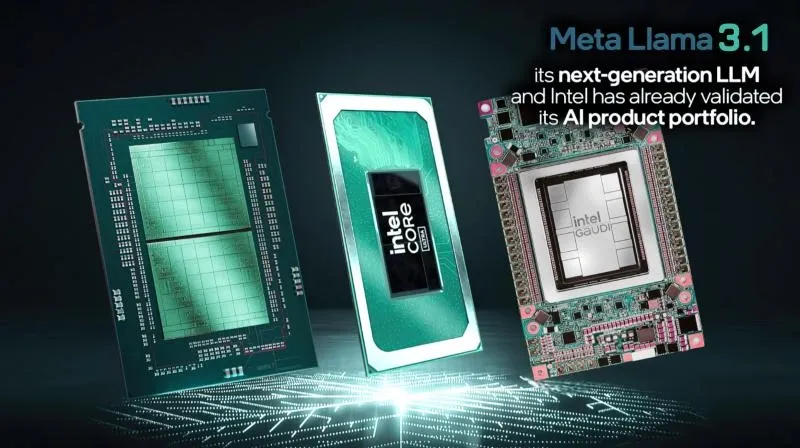
This system combines two Intel Emerald Rapids Xeon SP processors with 8 Intel Gaudi 3 accelerators to deliver cost-effective AI training and inference. - XD685 (Early 2025):
XD685 Dual AMD Turin Epyc CPU is equipped with flexible acceleration of 8 Nvidia Blackwell GPUs or 8 AMD MI300X/MI325X GPUs.
The air-cooled or liquid-cooled system with a high level of performance per watt boasts an innovative cooling system. All these are built to support high-performance enterprise AI and HPC workloads.
Storage Upgrades
HPE's new Cray E2000 All-Flash Array significantly boosts the storage performance required for next-gen supercomputing systems.
The array consists of 32 high-performance NVMe flash drives and two advanced storage servers, each with the latest PCIe 5.0 slots.

This design offers a tremendous improvement in data throughput, providing more than double the read and write performance than its predecessor, the E1000.
This massive improvement ensures accelerated data access, even for the most intensive and demanding workloads, making it a vital upgrade for high-performance computing environments.
The aggressive 2025 lineup of HPE affirms its commitment to redrawing the boundaries of supercomputing.
These new systems, powered by pioneering advances in networking, compute, and storage technologies, are meticulously engineered to offer unmatched performance, scalability, and adaptability.
In addressing complex requirements of traditional HPC applications and emerging AI workloads, HPE hopes to empower organizations with the tools needed to achieve exceptional computational efficiency and innovation.